
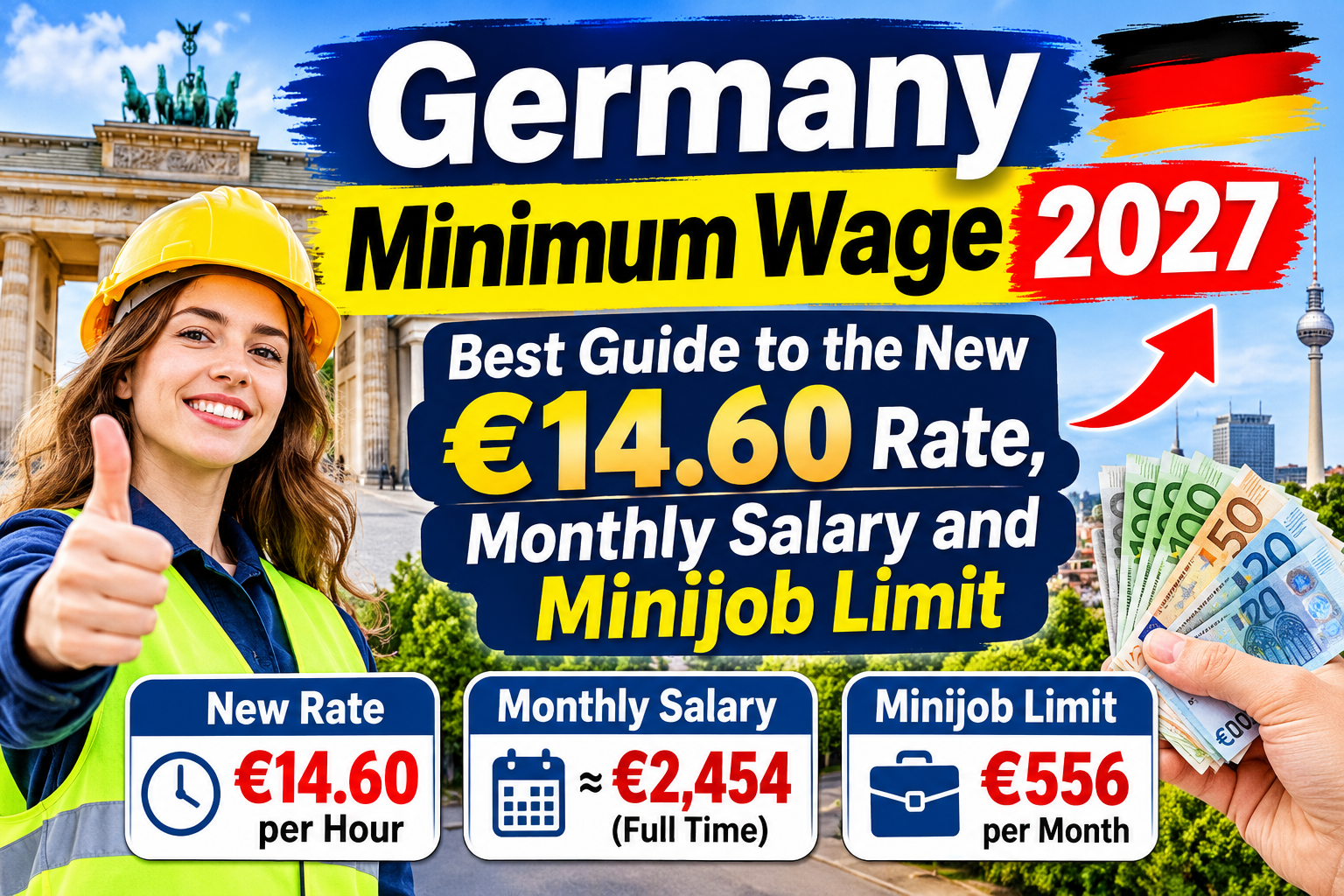
Planning to work in Germany or already working here? The Germany minimum wage 2027 rises to €14.60 gross per hour from 1 January 2027. This is the second increase in two years, and it affects helpers, warehouse staff, delivery drivers, students with part-time jobs, minijobbers and anyone starting on an entry-level contract.
In this guide you will learn the new hourly rate, what it means per month and per year, the new €633 minijob limit, who is not covered, whether you can live on it, and what foreigners from Pakistan, India and other countries should check before signing a job offer.

Table of Contents
Germany Minimum Wage 2027 at a Glance
- New hourly rate: €14.60 gross from 1 January 2027 (up from €13.90)
- Full-time monthly pay: about €2,531 gross for a 40-hour week
- Full-time yearly pay: about €30,370 gross
- Minijob limit: €633 per month (€7,596 per year)
- Who gets it: almost every employee in Germany, including foreigners
- Legal basis: the Fifth Minimum Wage Adjustment Ordinance
In short, the Germany minimum wage 2027 is the lowest hourly pay any employer may legally offer you, whatever your nationality, visa or job title.
What Is the Minimum Wage in Germany in 2027?
From 1 January 2027, the general statutory minimum wage in Germany (gesetzlicher Mindestlohn 2027) is €14.60 gross per hour. It rises from €13.90 in 2026, an increase of about 5%.
This is not a proposal. The rate is fixed by law in the Fifth Minimum Wage Adjustment Ordinance (Fünfte Mindestlohnanpassungsverordnung), which the federal government approved in October 2025 after the Minimum Wage Commission recommended it in June 2025. Both the 2026 and 2027 steps were set at the same time.
| Year | Minimum wage per hour | Change |
|---|---|---|
| 2025 | €12.82 | – |
| 2026 | €13.90 | +€1.08 |
| 2027 | €14.60 | +€0.70 |
Over two years, that is an increase of almost 14%, the largest since Germany introduced a minimum wage in 2015 at €8.50.
You can follow official updates on the website of the Minimum Wage Commission (Mindestlohnkommission), and employer guides such as this overview of the 2027 increase explain what companies must change in payroll.
Germany Minimum Wage History: 2015 to 2027
Looking at the history helps you see how fast pay at the bottom has grown in Germany:
| Date | Minimum wage per hour |
|---|---|
| January 2015 | €8.50 |
| January 2017 | €8.84 |
| January 2019 | €9.19 |
| January 2020 | €9.35 |
| January 2021 | €9.50 |
| July 2021 | €9.60 |
| January 2022 | €9.82 |
| July 2022 | €10.45 |
| October 2022 | €12.00 |
| January 2024 | €12.41 |
| January 2025 | €12.82 |
| January 2026 | €13.90 |
| January 2027 | €14.60 |
The biggest single jump came in October 2022, when parliament raised the rate to €12.00 by law. Since then the Minimum Wage Commission has set the steps again. Compared with 2015, the Germany minimum wage 2027 is about 72% higher.
Germany Minimum Wage 2027 Per Month and Per Year
Germany sets the minimum wage per hour, not per month. Your monthly pay depends on how many hours your contract says you work. A full-time week of 40 hours equals about 173.3 hours per month on average (40 × 52 ÷ 12).
| Weekly hours | Gross per month (2026, €13.90) | Gross per month (2027, €14.60) | Gross per year (2027) |
|---|---|---|---|
| 20 hours (part-time) | €1,205 | €1,265 | €15,184 |
| 30 hours | €1,807 | €1,898 | €22,776 |
| 38.5 hours | €2,319 | €2,436 | €29,229 |
| 40 hours (full-time) | €2,409 | €2,531 | €30,368 |
So a full-time worker on minimum wage earns roughly €2,530 gross per month in 2027, about €120 more than in 2026. Figures are rounded and do not include overtime, night or Sunday bonuses.
To work out the Germany minimum wage per month for your own contract, multiply €14.60 by your weekly hours, then by 52, and divide by 12. For example, 25 hours a week gives about €1,582 gross per month under the Germany minimum wage 2027.
Gross vs Net: How Much You Actually Take Home
The €14.60 is a gross (brutto) figure. Before your salary reaches your bank account, your employer deducts income tax and your share of social insurance: pension, health, long-term care and unemployment insurance.
As a rough guide, a single person in tax class I earning about €2,530 gross can expect to take home somewhere around €1,750–€1,850 net per month. The exact amount depends on your tax class, whether you pay church tax, your health insurance provider’s extra contribution and whether you have children. Always use an official German gross-to-net (Brutto-Netto) calculator with your own details before you budget.
For minijobbers the picture is different. Minijob pay up to €633 is usually free of income tax for the worker because the employer pays flat-rate contributions, although you pay a small pension contribution unless you opt out. Midijob earners pay reduced employee contributions that rise gradually as pay increases.
Minijob Limit 2027: €633 Per Month
The minijob earnings limit (Geringfügigkeitsgrenze) is linked by law to the minimum wage, so it rises automatically. The formula is the hourly minimum wage × 130 ÷ 3, rounded up to the next full euro.
| 2026 | 2027 | |
|---|---|---|
| Monthly minijob limit | €603 | €633 |
| Yearly limit (12 months) | €7,236 | €7,596 |
| Hours possible at minimum wage | about 43 per month | about 43 per month |
Two points many people miss:
- €633 is a ceiling, not a guaranteed salary. You only earn it if you work enough hours. If you work 32 hours a month at minimum wage, your pay rises from €444.80 to €467.20, not to €633.
- Midijobs now start above €633. If you earn more than the new limit, you move into the midijob range with reduced social insurance contributions.
International students should also remember their separate work-time limits. Read our guide to part-time jobs in Germany for international students for the full rules.
Germany Minimum Wage 2027 for Students and Part-Time Workers
The Germany minimum wage 2027 is not only for full-time staff. Every hour counts, so students, part-time workers and minijobbers get the same €14.60 per hour. A student working 20 hours a week during the semester earns about €1,265 gross a month, which is above the minijob limit and therefore a regular part-time or working-student (Werkstudent) job.
If you prefer to stay within a minijob 2027, you can work about 43 hours per month at the minimum wage before you reach €633. Many students combine a minijob during the semester with more hours in the holidays, but international students must still respect the yearly limit of 140 full days or 280 half days set by their residence permit.
Part-time workers on a fixed contract should check that their pay rises automatically in January. Under the minimum wage in Germany 2027 rules, an employer cannot keep paying the old €13.90 rate simply because your contract was signed earlier.
Who Is Not Covered by the Minimum Wage?
The minimum wage applies to almost every employee in Germany, including foreigners, minijobbers and seasonal workers. The law does list some exceptions:
- People under 18 without completed vocational training
- Apprentices in vocational training (Ausbildung), who receive a separate minimum training allowance instead
- Compulsory internships that are part of a study programme
- Voluntary orientation internships of up to three months
- Long-term unemployed people during their first six months in a new job
- Volunteers and self-employed freelancers
Some sectors also have their own higher sector minimum wages set by collective agreements, for example in care work and some trades. In those jobs the higher rate applies.
What the Germany Minimum Wage 2027 Means for Foreigners
If you come to Germany from Pakistan, India, Nigeria or anywhere outside the EU, the minimum wage protects you exactly like a German worker. Your nationality, visa type or language level does not change your right to at least €14.60 per hour.
- Opportunity Card holders: trial jobs and part-time work while you search must still pay at least the minimum wage. See our Germany Opportunity Card from Pakistan guide.
- Skilled worker visas: the minimum wage is only the floor. Visa routes like the EU Blue Card have their own, much higher salary thresholds. Check the EU Blue Card Germany 2027 thresholds and our Germany work visa 2027 guide before you apply.
- Job offers from abroad: if a contract signed before 2027 shows less than €14.60 per hour, the employer must still raise it to the legal rate from 1 January 2027.
- Cost of living: €2,530 gross is enough for a simple life in many smaller cities, but tight in Munich, Frankfurt or Hamburg where rents are high.
Can You Live on the Germany Minimum Wage 2027?
With roughly €1,750–€1,850 net per month at full time, many single workers can cover their basic costs. The real answer depends on the city you live in and how you share housing.
- Rent: the biggest cost. A room in a shared flat (WG) or a small studio in a smaller city often fits the budget, while a one-bedroom flat in Munich, Frankfurt or Hamburg can take more than half of your net pay.
- Health insurance: as an employee it is already deducted from your gross salary, so it does not come out of your net pay again.
- Transport: the Deutschlandticket 2027 covers local and regional transport across Germany for one fixed monthly price.
- Food and phone: cooking at home and shopping at discount supermarkets such as Aldi and Lidl keeps costs low.
Plan your budget carefully before you accept a full-time job paid at the Germany minimum wage 2027, especially if you also send money home to family.
Jobs That Often Start Near the Minimum Wage
Entry-level and helper roles often pay at or slightly above the minimum wage, especially when little German or no formal qualification is needed:
- Warehouse and logistics helpers (Lagerhelfer)
- Production and factory helpers
- Cleaning and housekeeping staff
- Kitchen helpers, dishwashers and restaurant service
- Retail and supermarket staff
- Delivery and courier jobs
- Seasonal agriculture work
Many of these employers hire foreigners directly, and some pay a little above the Germany minimum wage 2027 to attract staff, especially for night shifts, weekend work or physically demanding jobs.
Qualified roles usually pay far more. Compare salaries in our guides to truck driver jobs, electrician jobs, nursing jobs and IT jobs in Germany for foreigners.
How to Earn More Than the Minimum Wage in Germany
Starting on the minimum wage is normal for many newcomers, but you do not have to stay there. These steps usually lead to better pay:
- Improve your German. Moving from A2 to B1 or B2 opens customer-facing and skilled roles that rarely pay only the minimum.
- Do an Ausbildung. Vocational training gives you a recognised qualification. See our Ausbildung in Germany for foreigners guide.
- Switch careers as a Quereinsteiger. Many sectors train career changers on the job. Read our Quereinsteiger jobs in Germany guide.
- Get your qualification recognised. Recognition (Anerkennung) lets you work in your profession instead of helper jobs.
- Choose employers with a collective agreement. Jobs covered by a Tarifvertrag often pay more and include holiday or Christmas bonuses.
- Ask about shift bonuses. Night, Sunday and public holiday work often comes with extra pay on top of the base rate.
Think of the Germany minimum wage 2027 as your safety floor, not your target.
How to Check Your Employer Pays the Correct Wage
Use these five steps to make sure you receive at least the Germany minimum wage 2027:
- Calculate your real hourly rate. Divide your monthly gross salary by your actual monthly hours. If the result is below €14.60 from January 2027, something is wrong.
- Count unpaid overtime. Extra hours you work without pay lower your real hourly wage and can push it under the legal minimum.
- Check your January 2027 payslip. Your Lohnabrechnung should show the new rate or a higher monthly gross.
- Keep a record of your hours. A simple notebook or phone app helps if you ever need to prove a claim.
- Ask for help. The federal minimum wage hotline, trade unions and migrant advice centres can help free of charge if your employer underpays you.
Need a job you can start quickly without a German qualification? See our guide to warehouse jobs in Germany, including Lagerhelfer salary and the forklift licence.
Frequently Asked Questions
What is the minimum wage in Germany in 2027?
The general minimum wage in Germany is €14.60 gross per hour from 1 January 2027, up from €13.90 in 2026.
How much is the minimum wage per month in Germany in 2027?
For a 40-hour week, the minimum wage equals about €2,530 gross per month, or around €30,370 gross per year.
Is the €14.60 minimum wage confirmed?
Yes. It is set in the Fifth Minimum Wage Adjustment Ordinance, published in the Federal Law Gazette in November 2025.
Is the Germany minimum wage 2027 the same in every state?
Yes. The Germany minimum wage 2027 of €14.60 applies nationwide, in every federal state, with no difference between east and west.
What is the minijob limit in 2027?
The minijob limit rises to €633 per month, or €7,596 per year, from 1 January 2027.
Does the minimum wage apply to foreigners in Germany?
Yes. Every employee working in Germany is entitled to the minimum wage, regardless of nationality, visa or language skills, unless they fall into one of the legal exceptions.
When will the minimum wage rise again after 2027?
The Minimum Wage Commission reviews the rate every two years. Its next decision is expected in 2027 for the following years.
Final Thoughts
The Germany minimum wage 2027 of €14.60 per hour gives full-time workers about €2,530 gross a month and lifts the minijob limit to €633. For foreigners, it is a useful safety net, but not a career plan. If you have skills, a degree or vocational training, aim for roles that pay well above the minimum and qualify you for stronger visa routes. Start with our list of visa sponsorship jobs in Germany and English speaking jobs in Germany.

4 thoughts on “Germany Minimum Wage 2027: Best Guide to the New €14.60 Rate, Monthly Salary and Minijob Limit”