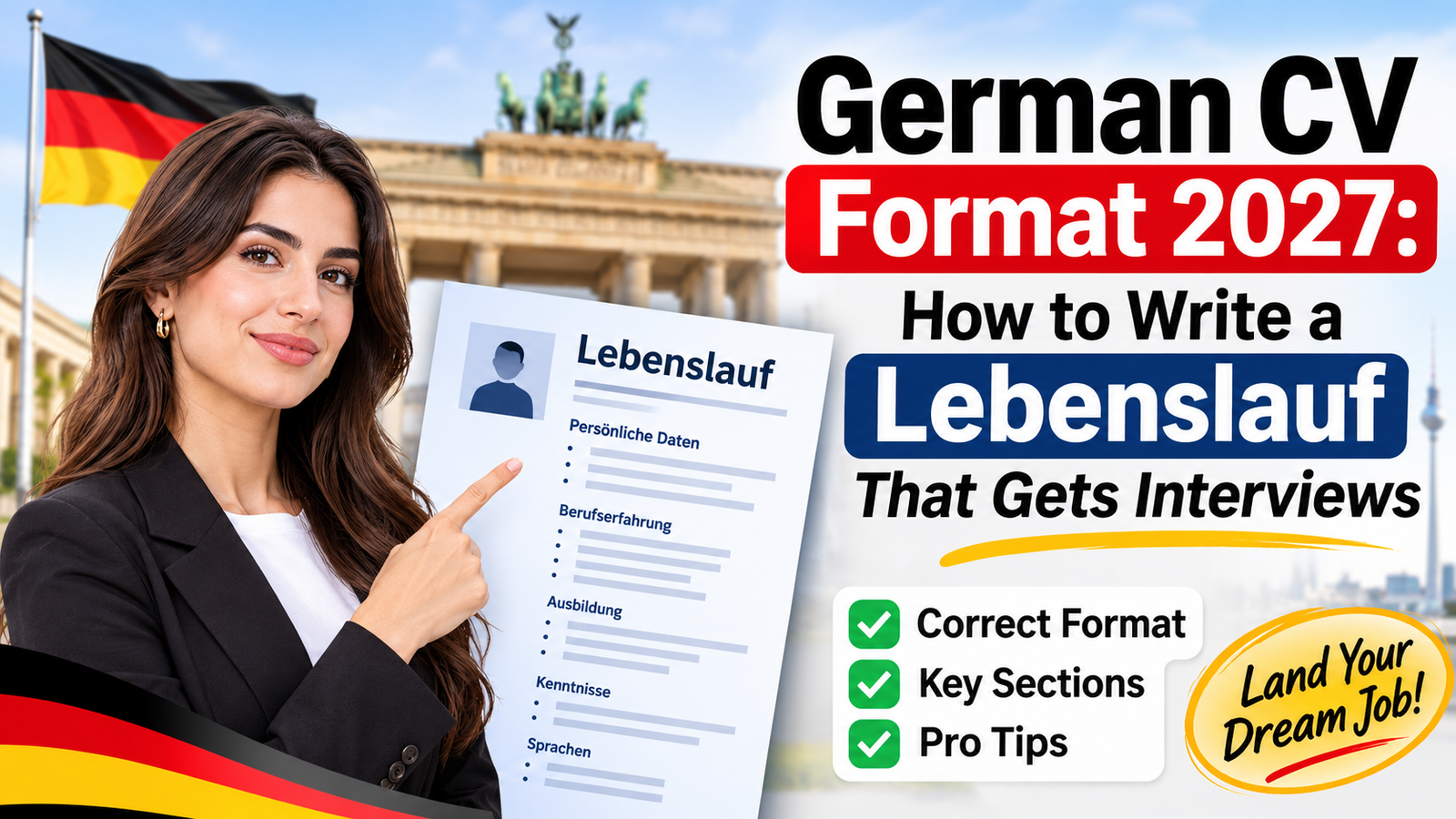
You found a good job in Germany, you sent the same CV you used in Pakistan or the Gulf, and nobody replied. Very often the problem is not your experience but the layout. The German CV format, called a Lebenslauf, follows rules that are different from a typical Pakistani, Indian, UK or US resume.
This guide shows you how to write a German CV in 2027: the right structure, which personal details to include, whether you need a photo and a signature, how long it should be, how to show your degree and German level, and the mistakes that get international applications rejected. At the end you will also find a short guide to the German cover letter (Anschreiben) and a CV example you can copy.
Table of Contents
German CV Format at a Glance
| Item | German standard |
|---|---|
| Name | Lebenslauf (tabellarischer Lebenslauf, a CV in table form) |
| Length | 1 page for graduates, up to 2 pages for experienced professionals |
| Order | Reverse chronological: newest job and degree first |
| Layout | Dates on the left, details on the right |
| Photo | Not legally required, but still common at traditional German companies |
| Personal details | Name, address, phone and email; date of birth and nationality are optional |
| Signature | Place, date and signature at the bottom are still common |
| File type | One PDF, usually together with your cover letter and certificates |
| Language | German if the job ad is in German, English if the ad is in English |
How a German CV Is Different from a Pakistani or English CV
Many Pakistani CVs start with a long career objective, list father’s name, CNIC, religion and marital status, and run to three or four pages. UK and US resumes are shorter but avoid photos and personal data. A German CV sits in the middle: short and factual like an English CV, but with a clear table layout, exact dates and often a photo.
The main differences are:
- No long career objective. If you want a summary, keep it to two or three lines (Kurzprofil).
- Exact dates in MM/YYYY format, for example 03/2022 to 08/2025.
- No unexplained gaps. If you were looking for work, caring for family or learning German, write it.
- No CNIC number, father’s name, religion or old salaries. German employers should not decide based on these details, so they only take up space.
- Everything must match your documents. German recruiters compare your CV with your degree, transcripts and experience letters (Arbeitszeugnisse).
The Structure of a German CV, Section by Section
A standard Lebenslauf uses the following sections in this order. You can shorten or leave out the optional ones.
1. Personal Details (Persönliche Daten)
Write your full name as it appears in your passport, your city and country, your phone number with country code (for example +92), a professional email address and, if you have one, your LinkedIn profile. Date of birth and nationality are optional. Many applicants from abroad still add their nationality, because it tells the employer straight away whether a visa will be needed.
Tip: if you apply from Pakistan, add a short line such as “Available for relocation to Germany” or “Eligible for the EU Blue Card” if that is true for you.
2. Professional Photo (Bewerbungsfoto)
A photo is not legally required, and many international companies and startups now prefer CVs without one. Traditional German companies, especially smaller family-owned firms, often still expect it. If you add a photo, use a recent professional picture with a neutral background and business clothing, placed at the top right of the first page. Never use a selfie, a cropped group photo or a copy of your ID card picture.
3. Short Profile (Kurzprofil), Optional
Two or three lines that say who you are and what you offer, for example: “Software engineer with 4 years of experience in Java and cloud systems, German B1, looking for a backend role in Germany.” Skip vague phrases like “hard-working team player”.
4. Work Experience (Berufserfahrung)
List each job with dates on the left and job title, company, city and country on the right. Under each job, write three to five short points about what you achieved, not only what your duties were. Numbers help: “reduced delivery errors by 20%” says more than “responsible for quality”.
If a Pakistani company name will mean nothing to a German recruiter, add a few words about it, such as “IT company with 200 employees serving US clients”.
5. Education (Ausbildung and Studium)
Write your degree name, university, city, country and final grade, newest first. For Pakistani grades, show your CGPA together with the scale, for example “CGPA 3.4 / 4.0”, or your percentage. Do not convert your grade to the German system yourself unless you have an official conversion.
If your degree is checked on Anabin or you have a ZAB Statement of Comparability, mention it here. Our guide to degree recognition in Germany from Pakistan explains both. You do not need to list your matric results once you have a university degree.
6. Language Skills (Sprachkenntnisse)
German employers expect levels from the European framework (A1 to C2), not words like “good” or “fluent”. Write, for example: “German: B1 (Goethe certificate, 2026)”, “English: C1 (IELTS 7.0)”, “Urdu: native”. Be honest. If you write B2 and the interview shows A2, you lose the job.
7. Skills (Kenntnisse)
List the software, tools and technical skills that match the job ad: for example SAP, Excel, AutoCAD, Python or a forklift licence. Use the same words as the job ad, because many companies screen applications with software first.
8. Certificates and Training (Weiterbildungen)
Add relevant courses and certificates with the year, such as a PMP, AWS or nursing course. Leave out short online courses that have nothing to do with the job.
9. Interests (Interessen), Optional
One line is enough. Interests can start a conversation in the interview, but they never replace experience.
10. Place, Date and Signature
End the CV with your city and the date in German format (DD.MM.YYYY), for example “Lahore, 15.11.2026”, followed by your signature. A scanned signature inserted into the PDF is fine.
German CV Example You Can Copy
This is a simple Lebenslauf example for an applicant from Pakistan. Replace the details with your own.
| Section | Example |
|---|---|
| Persönliche Daten | Ali Raza, Lahore, Pakistan, +92 300 0000000, ali.raza@email.com, Nationality: Pakistani |
| Kurzprofil | Mechanical engineer with 5 years of experience in production planning, German B1, open to relocation to Germany |
| Berufserfahrung | 06/2022 to today: Production Engineer, ABC Industries (Pvt) Ltd, Lahore. Planned production for 3 lines, cut machine downtime by 15% |
| Berufserfahrung | 07/2020 to 05/2022: Junior Engineer, XYZ Textiles, Faisalabad. Supported maintenance and quality checks |
| Studium | 09/2016 to 06/2020: BSc Mechanical Engineering, UET Lahore, CGPA 3.3 / 4.0 |
| Sprachkenntnisse | Urdu: native, English: C1, German: B1 (Goethe certificate) |
| Kenntnisse | AutoCAD, SolidWorks, MS Excel, Lean basics |
| Ort, Datum, Unterschrift | Lahore, 15.11.2026, signature |
Should You Write Your CV in German or English?
Follow the job ad. If the ad is in German, send your CV and cover letter in German. If it is in English, an English CV is fine. Many IT companies, startups and international firms work in English, as explained in our guide to English speaking jobs in Germany.
Do not use a translator to produce a German CV that suggests a level you do not have. Recruiters will often switch to German in the interview.
German CV Format for Different Situations
- Fresh graduates: keep it to one page and put education first, followed by internships, final-year project and skills.
- Skilled workers without a degree: highlight vocational training, licences and hands-on experience. Our guides to Quereinsteiger jobs and warehouse jobs in Germany show which roles hire this way.
- Nurses and other regulated jobs: state your recognition status (for example “Anerkennung in progress”) and your exact German level. See our guide to nursing jobs in Germany for foreigners.
- Opportunity Card applicants: make it clear that you are allowed to look for work in Germany. Read more about the Germany Opportunity Card from Pakistan.
How to Send Your Application
According to the official Make it in Germany portal, applications are usually sent as a PDF by email or uploaded on the company’s career website, and paper application folders are rarely needed.
- Combine your documents into one PDF in this order: cover letter, CV, then degree, transcripts and experience letters.
- Use a clear file name, such as Ali_Raza_Lebenslauf.pdf.
- Keep the file small enough to email, ideally a few megabytes.
- Read the end of the job ad carefully, because it often lists exactly which documents the company wants.
German Cover Letter (Anschreiben) in Short
Most German employers still expect a cover letter. Keep it to one A4 page and use the same design as your CV.
- Address a named person if the ad gives one, otherwise use “Dear Sir or Madam” (Sehr geehrte Damen und Herren).
- Start with why you want this specific job, not with your life story.
- In one or two paragraphs, connect your experience to the requirements in the ad.
- Mention your earliest start date and, if relevant, your visa situation.
- Give a salary expectation only if the ad asks for it.
- Close with “Kind regards” (Mit freundlichen Grüßen) and your signature.
Common German CV Mistakes to Avoid
- Sending a three- or four-page CV with a long career objective.
- Writing dates as years only, or leaving gaps unexplained.
- Adding CNIC, father’s name, religion or salary history.
- Using a casual photo or a low-quality scan.
- Writing “fluent German” instead of a CEFR level.
- Sending Word files or many separate attachments instead of one PDF.
- Using one generic CV for every job instead of matching it to each ad.
- Spelling mistakes in the company name or the contact person’s name.
Free Tools and Templates
The Europass CV is a free EU tool and a good starting point. Make it in Germany notes that German companies usually appreciate an individual design, so use Europass as a base and then adjust the layout. A clean Word or Google Docs template with one column also works well, because career portals read simple layouts more reliably than graphic-heavy designs.
Frequently Asked Questions
Does a German CV need a photo?
No, a photo is not legally required. It is still common at traditional German companies, while many international firms and startups prefer CVs without one. If you add a photo, make it professional.
How long should a German CV be?
One page for students and fresh graduates, and up to two pages for experienced professionals. Longer CVs are rarely read in full.
Do I need to sign my German CV?
It is not mandatory, but place, date and signature at the bottom are still common and look professional. A scanned signature in the PDF is fine.
Should I include my date of birth and marital status?
Both are optional. Date of birth is still often included. Marital status, religion and parents’ names are not needed.
Can I use the Europass CV in Germany?
Yes, but adjust the design. Europass is accepted, yet a personalised Lebenslauf usually makes a better impression.
Is the German CV format the same for visa applications?
For a student or work visa, the embassy may also ask for a CV. The same German CV format works well, but you can keep it shorter and focus on education and work history.
Final Thoughts
The right German CV format will not replace experience or language skills, but the wrong one can stop a German recruiter from reading further. Keep your Lebenslauf short, factual and in table form, use exact dates and CEFR levels, match every claim to a document and send everything as one clean PDF. Once your CV is ready, start applying through our guides to visa sponsorship jobs in Germany and the Germany work visa 2027.