
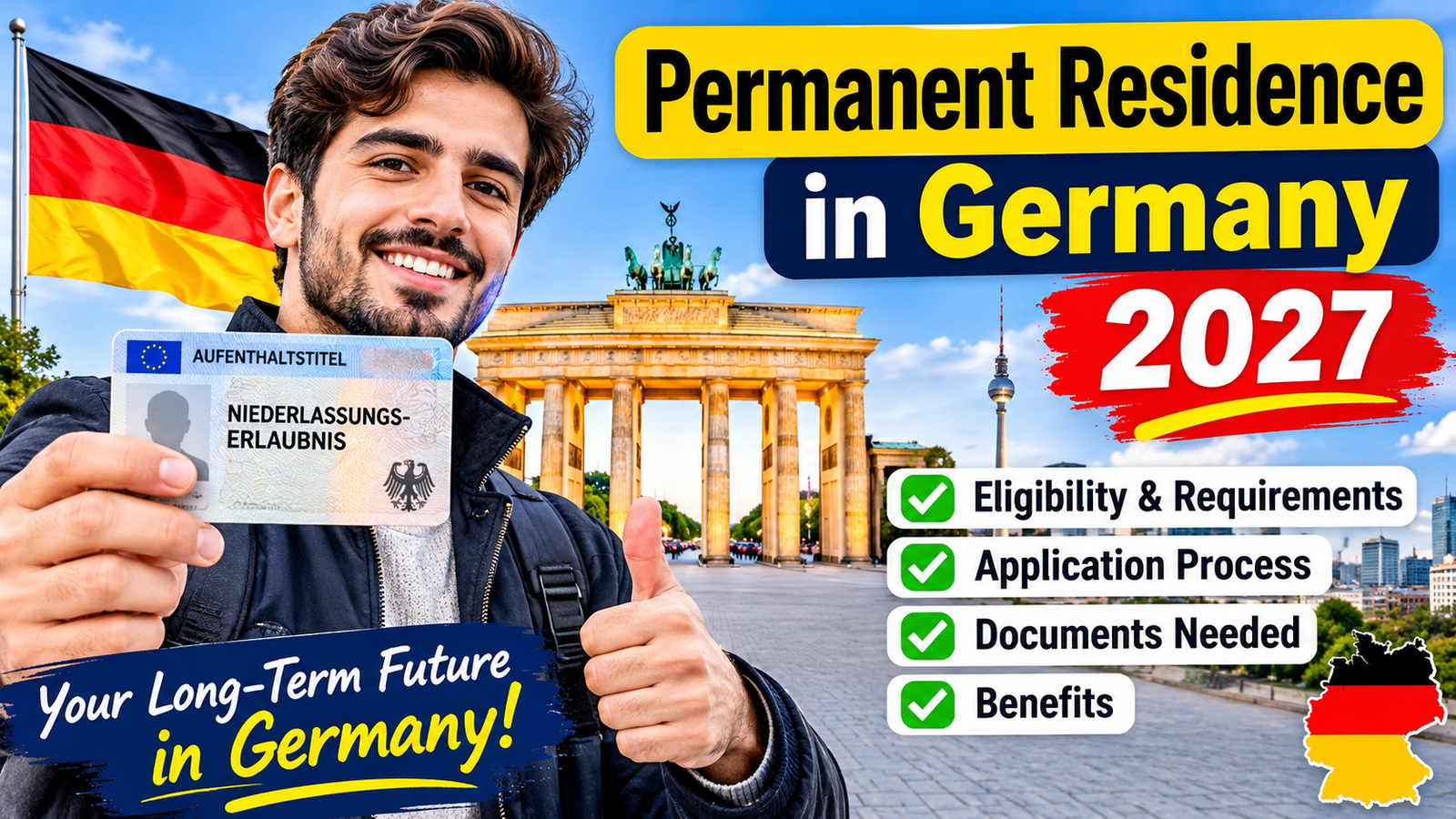
Most people who move to Germany for work start with a temporary residence permit. It is linked to a purpose, often your job, and it has to be renewed. The next big goal is permanent residence in Germany: a residence title with no expiry date that lets you change jobs freely and gives your family long-term security.
Skilled workers can get it much faster than many people think. Depending on your permit, the wait can be as short as 21 months. This guide explains every main route to Germany PR, the exact requirements, the documents, the fees and the mistakes that delay applications. The rules were checked in November 2026.

Table of Contents
Germany PR at a Glance
Find your situation below. The time shown is the earliest point at which you can normally apply for permanent residence in Germany if you also meet the other conditions.
| Your situation | Earliest PR | Pension months | German level |
|---|---|---|---|
| EU Blue Card holder | 27 months | 27 | A1 |
| EU Blue Card holder with B1 German | 21 months | 21 | B1 |
| Skilled worker (Sections 18a, 18b, 18d, 18g) | 3 years | 36 | B1 |
| Skilled worker with a German degree or Ausbildung | 2 years | 24 | B1 |
| Spouse of a skilled worker with a Section 18c settlement permit | 3 years | Ask your office | B1 |
| General route (settlement permit or permanent EU residence) | 5 years | 60 | B1 |
What Is Permanent Residence in Germany?
Germany has two permanent residence titles:
- Settlement permit (Niederlassungserlaubnis): the main form of Germany PR. It has no expiry date and allows any kind of work, including self-employment.
- Permanent EU residence permit (Erlaubnis zum Daueraufenthalt-EU): similar rights in Germany, plus better mobility inside and outside the EU.
With either title, you no longer depend on one employer. You can change jobs, start a business or take a break between jobs without your residence status being tied to that work.
Benefits of Permanent Residence in Germany
A temporary permit keeps your life tied to renewal dates and, often, to one type of job. Permanent residence in Germany removes much of that pressure and makes long-term decisions easier.
- No more renewals of your right to stay: the title itself has no expiry date. Only the physical card needs replacing from time to time.
- Freedom to change jobs: you can move to any employer or any type of work without asking for a new permit.
- Self-employment: you can start a business or work as a freelancer alongside or instead of a job.
- More security for your family: your stay no longer depends on keeping one specific position.
- A base for citizenship: you can stay settled in Germany while you work towards the five-year naturalisation requirement.
Settlement Permit vs Permanent EU Residence
Most skilled workers choose the Niederlassungserlaubnis because it has the fast routes. The EU permit suits people who have already reached five years and expect to spend long periods abroad. The Berlin immigration office explains the main differences.
| Point | Settlement permit | Permanent EU residence |
|---|---|---|
| Earliest application | 21 months to 5 years, by route | 5 years |
| Validity | Unlimited | Unlimited |
| Work rights | All work allowed | All work allowed |
| Time outside the EU | Can expire after more than 6 months without permission | Up to 12 months, or 24 months after an EU Blue Card |
| Living in another EU country | No special right | Up to 6 years without losing the permit |
| Standard fee in Berlin | €113 | €109 |
Requirements for Permanent Residence in Germany
Each route has its own waiting time, but the routes share most of the same basic conditions. Before you count your months, check that you can prove all of these:
- Secure income: you can cover your household costs without Bürgergeld or social assistance.
- Pension record: the required months of statutory pension contributions, or comparable provision.
- German skills: A1 or B1, depending on your route.
- Basic knowledge of Germany: usually shown with the “Living in Germany” test.
- Health insurance: German statutory cover or comparable private cover. Foreign insurance is not enough.
- Living space: enough room for you and the family members who live with you.
- Clean record: no threat to public safety or order. Convictions can block approval, and an open investigation can stop processing.
Route 1: PR for EU Blue Card Holders
The EU Blue Card is the fastest common path to permanent residence in Germany. According to the official Make it in Germany settlement permit page, Blue Card holders need:
- At least 27 months in qualified employment with statutory pension contributions
- German at A1 level
- Basic knowledge of the legal and social system, usually shown by passing the “Living in Germany” test
- Enough living space for you and your family
- Enough income to cover your living costs
If you prove German at B1 level, the wait drops from 27 to 21 months. Learning German early is the single best way to get PR faster. Our guide to the EU Blue Card Germany 2027 explains the salary threshold and how to qualify.
Route 2: PR for Skilled Workers After 3 Years
For many newcomers, this is the standard route to Germany PR. If you came on a regular skilled worker permit, for example under Section 18a for vocational training or Section 18b for a degree, you can apply after three years. You need:
- Three years on a residence title under Section 18a, 18b, 18d or 18g
- A current job that your permit allows you to do as a skilled worker
- At least 36 months of statutory pension contributions or comparable provision
- German at B1 level
- The “Living in Germany” test or equal proof of basic knowledge
- Enough income without state benefits and enough living space
The Berlin skilled worker page says time on a national visa can count if you were already working as a skilled worker under it. This is the normal route for most people who arrive through the Germany work visa 2027. If your qualification is foreign, read our guide to degree recognition in Germany from Pakistan first.
Route 3: After Ausbildung or University in Germany
If you completed vocational training or a university degree in Germany, the wait is shorter. You can apply after two years on a skilled worker permit, with 24 months of pension contributions, B1 German and the “Living in Germany” test.
This makes studying or training in Germany a strong long-term plan. Time on a student permit does not start this two-year clock, so you first have to move to a skilled worker permit after graduating. See our guides to the Germany student visa from Pakistan and Ausbildung in Germany for foreigners.
Route 4: Spouses of Skilled Workers
A spouse or registered life partner can get a Niederlassungserlaubnis after three years instead of five when:
- The partner holds a settlement permit as a skilled worker under Section 18c
- The spouse has held a residence permit for at least three years, not on humanitarian grounds
- The couple has lived together in the marriage or partnership for at least three years
- The spouse works at least 20 hours per week
- The spouse has B1 German and basic knowledge of life in Germany
The other general conditions, including income and living space, still matter, so ask your office how it treats pension months for spouses. Our guide to the Germany family reunion visa from Pakistan explains how a spouse can join you first.
Route 5: General PR After 5 Years
If none of the faster routes fit, you can still get permanent residence in Germany through the general route. It leads to either a settlement permit or the permanent EU residence permit. You normally need five years of legal residence, 60 months of pension contributions, B1 German, basic knowledge of life in Germany, enough living space and secure income.
Half of your legal time in Germany for study or vocational training can count towards the five years. You normally cannot receive the permit while you still hold a study or training permit, so confirm your own calculation with the immigration office.
Other Routes to a Settlement Permit
A few smaller groups can get a Niederlassungserlaubnis under separate rules:
- Business owners: people with a self-employment permit under Section 21 can apply after three years if the business is successful and supports them.
- Freelancers: a permit under Section 21(5) generally leads to a settlement permit after five years.
- Highly skilled workers: in special cases, Section 18c(3) allows a settlement permit without a waiting period.
- Family of German citizens and recognised refugees: separate rules apply, so check the page for your group.
The BAMF overview of open-ended residence titles is a useful official starting point for these groups.
Which Germany PR Route Is Best for You?
The best route is usually the shortest one you can actually prove on paper. Use these simple rules to choose:
- You hold an EU Blue Card: aim for B1 German and apply at 21 months. If B1 will take longer, A1 still allows you to apply at 27 months.
- You studied or trained in Germany: move to a skilled worker permit quickly, because your two-year clock starts there.
- You hold a skilled worker permit: plan for three years and book your B1 exam during your second year.
- Your partner already has a skilled worker settlement permit: check whether a job of at least 20 hours per week could bring you the three-year spouse route.
- You hold another type of permit: count your years for the general route, and ask whether changing to a skilled worker permit would help.
If you could qualify for two routes, compare both dates before you apply. A short language course can sometimes save you six months or more.
Example Timeline: When Could You Apply?
Imagine you start work in Germany in January 2027, keep paying pension contributions without a gap and meet every other condition. Your earliest Germany PR application dates would look like this:
| Route | Months needed | Earliest date |
|---|---|---|
| Blue Card with B1 German | 21 | October 2028 |
| German degree or Ausbildung, skilled worker permit | 24 | January 2029 |
| Blue Card with A1 German | 27 | April 2029 |
| Skilled worker permit | 36 | January 2030 |
| General route | 60 | January 2032 |
The gap between the first and last line is more than three years. German language skills and the right permit make most of that difference.
German Language and the Living in Germany Test
Most routes to permanent residence in Germany need B1, which means you can handle everyday situations at work and in daily life. A language certificate is the simplest proof, but the Berlin settlement permit page also accepts other evidence, including:
- A completed integration course
- A recognised vocational qualification or German-language vocational training
- A German-language degree from a university or university of applied sciences
- At least four years at a German general school with the required results
The “Living in Germany” test (Leben in Deutschland) is a multiple-choice test about German law, society and history. It is the usual proof of basic knowledge. Adult education centres (Volkshochschule) and other approved providers offer it.
Documents You Usually Need
Each immigration office (Ausländerbehörde) has its own checklist, so always check your local office website. Most applicants need:
- Valid passport and current residence permit
- Biometric photo, if your office asks for one
- Employment contract and a recent employer certificate (Berlin wants one no older than 14 days)
- Net pay records, often for the last six months
- Pension insurance record (Versicherungsverlauf)
- German language certificate or other accepted proof
- “Living in Germany” test certificate
- Rental contract and proof of your warm rent and living space
- Proof of German health insurance
- Your German degree or vocational certificate, if you use the two-year route
How to Apply Step by Step
- Check your date. Count your months on the right permit and your pension contribution months.
- Get your German certificate. Book a Goethe, telc or ÖSD exam early, because test dates fill up.
- Pass the “Living in Germany” test. Register well before you plan to apply.
- Request your pension record. You can order it free from Deutsche Rentenversicherung.
- Collect your documents. Use the checklist from your local immigration office.
- Apply online or book an appointment. The method depends on your city.
- Pay the fee and attend your appointment. Your fingerprints and details may be taken for the new card.
- Collect your electronic residence card. Your office will tell you when it is ready.
Germany PR Fees
Official Berlin pages list these totals. Berlin splits each amount into a processing fee and an issuing fee. Fees can differ for some groups, so confirm the amount with your own office.
| Permit | Total fee in Berlin |
|---|---|
| General settlement permit | €113 |
| Settlement permit for skilled workers | €113 |
| Settlement permit for skilled workers with a university degree | €147 |
| Permanent EU residence permit | €109 |
How Long Does It Take?
Processing times depend on the city. Busy offices can take several months to offer an appointment. In Berlin, the card is issued at least four weeks after the appointment.
Apply as soon as you are eligible and keep your current permit valid while you wait. If it is about to expire, ask the office for a certificate that confirms your application is being processed (Fiktionsbescheinigung).
Common Mistakes That Delay Germany PR
- Applying before the required months are complete
- Gaps in pension contributions, for example during unemployment or unregistered work
- Bringing the wrong language level or no certificate
- Forgetting the “Living in Germany” test until the last moment
- A flat that is too small for your family
- Changing to a job your skilled worker permit does not cover
- Long stays abroad. A settlement permit can expire if you leave Germany for more than six months without permission from the immigration office.
From PR to German Citizenship
Permanent residence in Germany is not the same as citizenship. You can usually apply for a German passport after five years of legal residence if you meet the other conditions. The three-year fast track ended on 30 October 2025, so five years is now the standard minimum.
Germany currently allows dual citizenship, so it no longer asks most applicants to give up their old nationality. Check the rules of your home country too, because they can differ.
Frequently Asked Questions
Can I get permanent residence in Germany without speaking German?
Usually not. Blue Card holders need at least A1 German and most other routes require B1. Exceptions exist, for example when a permanent illness makes learning German unreasonable.
Does time on the Opportunity Card count towards PR?
It does not count towards the fast skilled worker or Blue Card periods. Those depend on holding the right permit and doing the right job. Ask your office whether it can count towards the general five-year route. Read more about the Germany Opportunity Card from Pakistan.
Do I need a minimum salary for PR?
There is no single PR salary. You must cover your household costs without state benefits, so the amount depends on your rent and family size. Blue Card holders also need the required months in qualifying Blue Card employment.
Can I apply if I lose my job?
It becomes difficult. The skilled worker route requires a current qualifying job, and every main route requires secure income. Try to find new work before you apply.
How much does a settlement permit cost?
In Berlin, the standard total for a Niederlassungserlaubnis is €113, and skilled workers with a university degree pay €147. Confirm the amount with your local office.
Can I lose my settlement permit?
Yes. A Niederlassungserlaubnis can expire if you live outside Germany for more than six months without the immigration office giving permission. It can also end after serious criminal offences.
Is PR the same as a German passport?
No. PR lets you live and work in Germany permanently, but you remain a citizen of your home country. Citizenship is a separate application.
Final Thoughts
Permanent residence in Germany is closer than many newcomers think: 21 months for Blue Card holders with B1 German, two years after studying or training in Germany, and three years for most skilled workers. Start learning German from day one, keep your pension contributions free of gaps and collect your documents early. Immigration rules can change, so confirm your case with your local office before you apply.
