
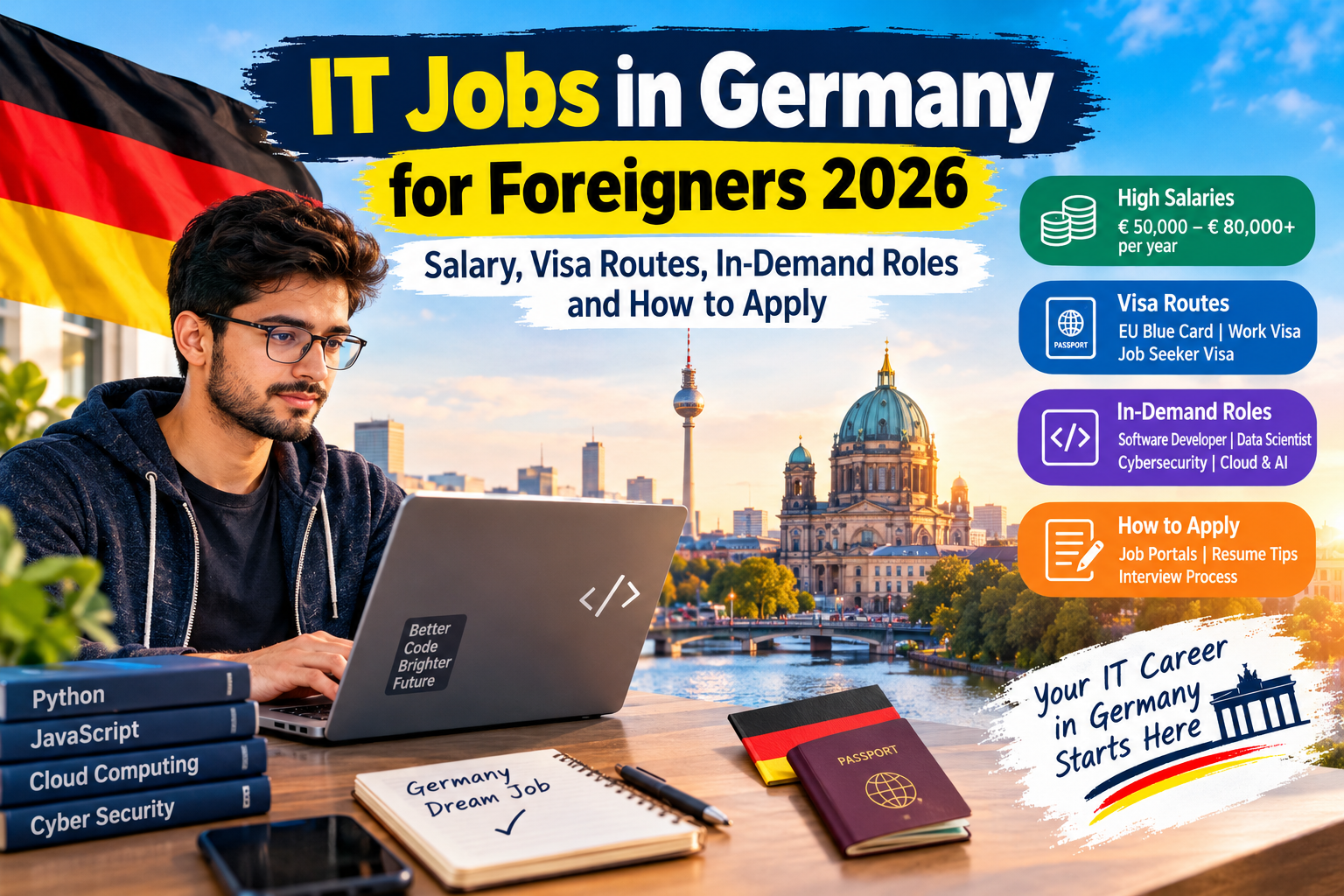
Germany has been short of IT professionals for more than a decade, and 2026 is no different. Companies still struggle to fill roles in system administration, software development, cloud and cybersecurity, and many now look beyond Europe to find talent. For developers, admins and engineers from Pakistan, India, Africa and the Middle East, IT jobs in Germany for foreigners are one of the fastest and most rewarding ways to build a successful career in Europe, often without speaking German and, in some cases, even without a university degree.
In this complete guide to IT jobs in Germany for foreigners, you will learn which roles are in demand, what you can earn in 2026, which visa route fits your profile, the documents you need and the exact steps to apply from your home country.

Table of Contents
IT Jobs in Germany for Foreigners: Quick Facts (2026)
| Topic | Details |
|---|---|
| IT specialists still missing | About 79,000 (Bitkom, September 2026) |
| Most wanted role | IT administration and system operations |
| Blue Card minimum salary for IT | €45,934.20 gross per year (2026) |
| Degree required? | Not always: 3 years of IT experience can replace it |
| German required? | Not for the visa, but it helps a lot with hiring |
| Where to apply for the visa | German embassy or consulate, via the online Consular Services Portal |
Why IT Jobs in Germany for Foreigners Are in High Demand
According to the latest Bitkom study published in September 2026, around 79,000 IT positions in Germany remain unfilled. That is lower than the record of 149,000 in 2023, but the market is still tight:
- 97 percent of companies with open IT jobs say they have difficulty filling them.
- 78 percent of companies currently see a shortage of IT specialists, and about three quarters expect it to get worse in the coming years.
- Almost a third of companies receive practically no applications for their IT vacancies.
- Artificial intelligence is changing IT work, but so far very few companies have cut IT jobs because of it. Instead, demand is growing for people who can work with AI tools.
An ageing workforce, the digitalisation of public administration and the growing need for IT security mean this gap will not close soon. German law treats IT as a shortage occupation, which is why IT jobs in Germany for foreigners come with easier visa rules and a lower salary threshold than most other professions.
Most In-Demand IT Jobs in Germany for Foreigners
Bitkom asked companies with vacant positions which IT profiles they are looking for. Here is what they said, along with the German job titles you will see in adverts:
| IT field | Typical job titles (German) | Share of companies hiring |
|---|---|---|
| IT administration and system operations | Systemadministrator, IT-Administrator | 26% |
| Software development and architecture | Softwareentwickler, Softwarearchitekt | 17% |
| Cloud and infrastructure | Cloud Engineer, DevOps Engineer | 14% |
| Artificial intelligence | KI-Entwickler, Machine Learning Engineer | 12% |
| IT security | IT-Sicherheitsexperte, Security Analyst | 11% |
| IT consulting | IT-Berater, SAP-Berater | 9% |
| Data science | Data Scientist, Data Engineer | 7% |
| Quality assurance and testing | Softwaretester, QA Engineer | 6% |
If you have experience in Linux or Windows server administration, cloud platforms like AWS or Azure, Java, Python, .NET, SAP or cybersecurity, your chances are excellent. In practice, the best IT jobs in Germany for foreigners are in fields where companies cannot find enough local candidates, such as system administration, cloud and security.
IT Jobs in Germany for Foreigners: Salary in 2026
Salaries for IT jobs in Germany for foreigners are the same as for German employees: they depend on your role, experience, city and the size of the company, not on your nationality. Based on major salary databases for 2026, these are realistic gross annual ranges for software developers and similar roles:
| Experience level | Typical gross salary per year |
|---|---|
| Entry level (0 to 2 years) | €45,000 to €55,000 |
| Mid level (3 to 6 years) | €60,000 to €75,000 |
| Senior (7+ years) | €80,000 to €100,000+ |
- Munich, Frankfurt and Stuttgart usually pay the most, but rent is also highest there.
- Berlin has the most English-speaking startups, with salaries slightly below Munich.
- Cloud, security, SAP and AI specialists are often paid above these averages.
- German salaries are quoted gross. Tax and social insurance usually take 35 to 42 percent for a single person.
For a visa, your offer must also meet the legal minimum salary explained below. In 2026 that is €45,934.20 gross per year for an EU Blue Card in IT, which is roughly €3,828 per month.
Requirements for IT Jobs in Germany for Foreigners
The good news is that the requirements for IT jobs in Germany for foreigners are simpler than in many other fields. Most employers and visa officers look at four things:
- Skills and experience: a recognised IT degree, a recognised vocational qualification, or proven professional IT experience.
- A concrete job offer: a signed contract or binding offer from a German employer.
- Minimum salary: the offer must reach the legal threshold for your visa type.
- Language: English is often enough for the job, and German is a strong plus.
Do You Need German for IT Jobs in Germany for Foreigners?
No German is required for the IT visa itself, and many international companies and startups use English as their working language. A large share of IT jobs in Germany for foreigners are advertised in English, especially in Berlin and Munich. You can explore these roles in our guide to English speaking jobs in Germany.
However, German still matters. In the 2026 Bitkom survey, 47 percent of companies said missing German skills was a problem when hiring. Even basic German (A2 to B1) makes you more attractive to mid-sized companies outside Berlin, helps in daily life and speeds up permanent residence.
Visa Routes for IT Jobs in Germany for Foreigners
Germany offers several visa options for IT jobs in Germany for foreigners from outside the EU. Which one fits you depends on your degree, experience and job offer. All figures below are for 2026.
| Visa route | Who it is for | Main requirements |
|---|---|---|
| EU Blue Card (with degree) | IT graduates | Recognised university degree, job offer of at least €45,934.20 per year |
| EU Blue Card (without degree) | Experienced IT professionals | At least 3 years of IT experience in the last 7 years, job offer of at least €45,934.20 per year, approval from the Federal Employment Agency |
| IT specialist visa (Section 19c(2)) | Self-taught or non-graduate IT workers | At least 2 years of IT experience in the last 5 years, job offer of at least €45,630 per year, approval from the Federal Employment Agency |
| Skilled worker visa (Section 18a / 18b) | Those with recognised training or a degree who do not meet Blue Card rules | Recognised qualification and a matching job offer |
| Opportunity Card (Chancenkarte) | People without a job offer yet | Points-based, lets you search for a job inside Germany for up to 1 year |
EU Blue Card: The Best Option for Most IT Workers
The EU Blue Card is the most popular choice for IT jobs in Germany for foreigners because your family can join you, your spouse can work from day one, and you can get permanent residence after 27 months, or after 21 months with B1 German. Because IT is a shortage occupation, you only need the lower salary threshold. Read our full EU Blue Card Germany guide for documents and the upcoming 2027 changes.
No Degree? You Can Still Qualify
This is what makes IT special. Since the Skilled Immigration Act reforms, IT professionals can get a Blue Card based on at least three years of relevant experience within the last seven years, instead of a degree. Keep proof of every job: employment contracts, experience letters, salary slips and certificates from courses or vendor exams like AWS, Microsoft or Cisco.
No Job Offer Yet? Use the Opportunity Card
If you want to search for IT jobs from inside Germany, the Opportunity Card allows you to stay for up to a year and work part time while you look. See our step-by-step guide to the Germany Opportunity Card from Pakistan.
Entry-Level IT Jobs in Germany for Foreigners and Fresh Graduates
Entry-level IT jobs in Germany for foreigners do exist, but competition is stronger than for experienced roles. Recent graduates benefit from the same reduced Blue Card salary threshold as shortage occupations if they finished their degree within the last three years.
- Look for titles like Junior Developer, IT Support Specialist, Junior System Administrator or Werkstudent (student job).
- Build a small portfolio on GitHub with real projects; German recruiters value practical work.
- Earn one or two respected certifications, such as AWS Cloud Practitioner, Microsoft Azure Fundamentals or CompTIA Security+.
- Consider studying in Germany first; graduates get 18 months to find a job after their degree.
How to Apply for IT Jobs in Germany for Foreigners: Step by Step
- Check your qualification. If you have a degree, search for your university on the anabin database. If it is not listed, you may need a statement of comparability from the ZAB. Without a degree, collect proof of at least three years of IT experience.
- Prepare a German-style CV. Keep it to two pages, add a professional photo (optional but common), list your tech stack clearly and include exact dates for each job.
- Apply to jobs that mention relocation or visa sponsorship. Use the job portals listed below and focus on companies that already hire internationally. Our guide to visa sponsorship jobs in Germany explains what to look for.
- Pass the interviews. Most IT hiring includes a screening call, a technical test or coding task, and a final interview, often fully online.
- Sign the contract. Check that the gross annual salary meets the visa threshold for 2026.
- Apply for your visa online. In Pakistan and many other countries, work visas are submitted through the Federal Foreign Office Consular Services Portal. You upload your documents, get them checked, then book an appointment for biometrics and the fee.
- Wait for approval. If your case needs Federal Employment Agency approval, plan for a few extra weeks. After arrival, register your address (Anmeldung) and collect your residence permit.
Documents Checklist for Your IT Work Visa
Prepare these documents early, because missing papers are the most common reason applications for IT jobs in Germany for foreigners get delayed:
- Valid passport and biometric photos
- Signed employment contract or binding job offer
- Degree certificate and transcripts, or proof of IT work experience
- Experience letters with job titles, dates and main tasks
- Updated CV in English or German
- Completed visa application from the online portal
- Proof of health insurance from your start date
- Federal Employment Agency approval form, if your employer has already obtained it
Where to Find IT Jobs in Germany for Foreigners
- Make it in Germany job listings: the official government portal, with jobs open to international applicants.
- Bundesagentur für Arbeit Jobbörse: Germany’s largest public job board.
- LinkedIn: very active for IT recruiting; set your location preference to Germany and turn on “Open to work”.
- StepStone and XING: popular German job boards where many mid-sized companies post.
- GermanTechJobs and Berlin Startup Jobs: specialised boards for developers and startup roles, many in English.
You can also follow our Latest Germany Jobs section, where we regularly publish new IT jobs in Germany for foreigners along with practical guides.
Best Cities for IT Jobs in Germany for Foreigners
| City | Why it is good for IT |
|---|---|
| Berlin | Biggest startup scene, most English-speaking teams |
| Munich | Highest salaries, big tech, automotive and enterprise software |
| Hamburg | E-commerce, media and logistics tech |
| Frankfurt | Banking, fintech and data centres |
| Stuttgart | Automotive software and engineering |
| Cologne and Düsseldorf | Telecom, insurance and many mid-sized companies |
Working Remotely vs Relocating to Germany
Some German companies hire developers abroad as remote contractors. This can be a useful first step, but it does not give you a residence permit, health insurance in Germany or a path to permanent residence. If your long-term goal is to live in Europe, a relocation role with a proper German employment contract is the better choice.
Many employers now offer a mix of both: you start remotely during the visa process and move to Germany once your permit is approved. Ask about relocation support during your interviews, because some companies pay for flights, temporary housing and German classes for the first months.
Tips to Get Hired Faster
Thousands of candidates apply for IT jobs in Germany for foreigners every month. These simple habits help you stand out:
- Tailor every application. Match the keywords in the job advert, such as the exact tools and frameworks they mention.
- Show results, not duties. Write “reduced server downtime by 30 percent” instead of “responsible for servers”.
- Mention your visa route. Telling employers you qualify for the EU Blue Card removes a big worry for them.
- Start learning German now. Even an A1 or A2 certificate shows commitment.
- Network on LinkedIn. Connect with recruiters and engineers at your target companies and ask short, polite questions.
Pros and Cons of IT Jobs in Germany for Foreigners
| Pros | Cons |
|---|---|
| Strong demand and high salaries | High taxes and social contributions |
| Easy visa routes, even without a degree | Rent is expensive in big cities |
| Family can join on the Blue Card | German is needed for daily life and some employers |
| Fast path to permanent residence | Bureaucracy and paperwork can be slow |
Avoid Job and Visa Scams
Fake offers often target people searching for IT jobs in Germany for foreigners. Protect yourself with these rules:
- Real German employers never ask you to pay for a job offer or work contract.
- Visa applications are made only through the official German embassy, consulate or the Consular Services Portal, never through a private “guaranteed visa” agent.
- Check that the company exists: look for its website, an Impressum page and its profile on LinkedIn.
- Be careful with offers that promise a high salary without any interview.
Before you apply, check whether your degree is accepted: our guide to degree recognition in Germany from Pakistan explains Anabin, the ZAB statement and Anerkennung step by step.
Frequently Asked Questions
Are IT jobs in Germany for foreigners still in demand in 2026?
Yes. Even though the gap has become smaller, Germany still lacks about 79,000 IT specialists, so IT jobs in Germany for foreigners remain among the most in-demand opportunities in Europe.
Can I get an IT job in Germany without a degree?
Yes. With at least three years of relevant IT experience in the last seven years and a job offer paying at least €45,934.20 per year, you can apply for an EU Blue Card without a degree. A separate IT specialist visa is also available for people with at least two years of experience.
Is it possible to work in IT in Germany with English only?
Yes, especially in Berlin, Munich and at international companies and startups. Learning some German will still widen your options and help you settle.
What is the minimum salary for an IT visa in Germany in 2026?
For an EU Blue Card in IT, the minimum is €45,934.20 gross per year. For the IT specialist visa under Section 19c(2), it is €45,630 gross per year. These amounts are updated every January.
How long does the German work visa take from Pakistan?
It depends on the embassy workload and whether the Federal Employment Agency must approve your job. Since the move to the online portal, the process has become faster, but you should still plan for several weeks to a few months.
Final Thoughts
IT jobs in Germany for foreigners remain one of the most accessible and rewarding paths to a European career. The demand is real, the salaries are strong, and the visa rules for IT are more flexible than for almost any other profession, even if you do not have a degree or speak German yet.
Prepare your documents, polish your CV, target companies that sponsor visas and apply through official channels only. With the right preparation, IT jobs in Germany for foreigners can open the door to a stable, well-paid future for you and your family.
Note: Salary thresholds and visa rules change regularly. Always confirm the latest requirements on the official Make it in Germany website or with the German embassy before you apply.

2 thoughts on “IT Jobs in Germany for Foreigners 2026: Best Guide to Great Salary, Easy Visa Routes and Proven Steps to Apply”